For US construction contractors

Construction weather software built for American job sites

Document weather delays on your schedule. Plan daily operations by trade. Issue contractual weather notices and build a reproducible, independently verifiable weather record that supports a weather delay claim under AIA, ConsensusDocs or FAR contracts.

AIA A201 ConsensusDocs FAR / DFARS FIDIC Trade thresholds
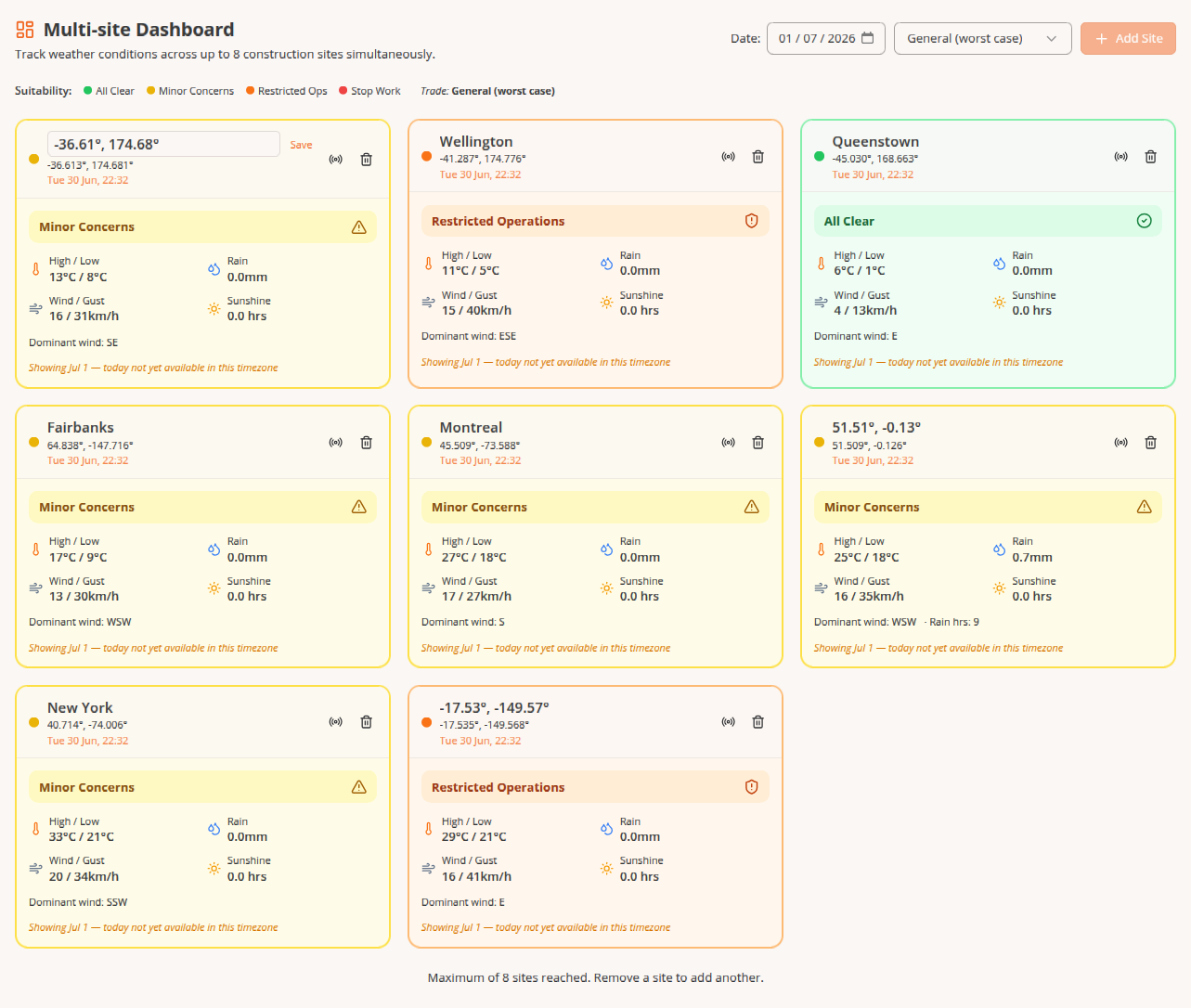
Construction weather dashboard showing project weather data and trade advisory cards

The weather delay problem

Weather delays cost US contractors billions every year

Weather is one of the most common causes of construction schedule delays — yet most contractors document it poorly. A generic weather app screenshot does not satisfy the notice requirements in AIA A201, ConsensusDocs or a FAR-based federal contract. When the delay claim reaches the project owner's representative or a disputes board, undocumented weather events are denied.

Step 1
Price it at bid

Use 10 years of location-specific historical data to calculate realistic weather-day allowances by trade and project month. Avoid underpricing weather risk — and the extended general conditions costs that follow when your allowance runs out mid-schedule.

Step 2
Plan daily operations

Check whether today's or tomorrow's conditions are suitable for the planned trade operation before mobilising the crew. Green, Amber and Red advisory grading across 20+ operations — concrete, crane lifts, roofing, earthworks and more.

Step 3
Issue weather notices

Generate a structured weather notice draft before adverse conditions arrive. Maintain the contemporaneous weather records that contract administrators and owners' representatives require when reviewing a delay claim.

Step 4
Recover delay costs

Benchmark the affected project month against a 5–10 year historical average. Identify qualifying weather events. Frame the evidence for a time extension or Request for Equitable Adjustment — and recover extended general conditions and liquidated damages exposure.

Built for contract administration — not weather apps

Most construction weather tools stop at the forecast. Construction Weather is designed around what comes next: the contractual notice, the schedule impact and the delay claim. Every output — trade advisory, weather notice draft, delay evidence pack — is structured for construction decision-making and contract administration under standard US forms, not general public use.

  • Trade-specific risk grading against configurable operational thresholds
  • Contemporaneous records built automatically from daily advisory checks
  • Historical benchmarking across 5–10 years to prove conditions were exceptional
  • ERA5/Open-Meteo data — reproducible and independently verifiable
  • Structured for AIA, ConsensusDocs, FAR and FIDIC contract requirements
20+trade operations
14-dayforecast
5–10 yearhistorical benchmark
Globalcoverage
Nohardware required

US contract requirements

What AIA, ConsensusDocs and FAR require for a weather delay claim

Each major US construction contract form has specific requirements for weather delay entitlement. All share a common thread: the contractor must demonstrate that conditions were exceptional, that notice was given on time, and that the delay actually affected the critical path. For the clause-by-clause detail — including notice deadlines and documentation standards — read the full guide to weather delay claims under AIA, ConsensusDocs and FAR contracts.

AIA A201 General Conditions

Section 8.3 of AIA A201 permits a time extension for delays caused by "adverse weather conditions." The contractor must show conditions were "unusual for the time of year at the project location" — which requires comparison against historical norms. Strict claim notice requirements apply (see §15.1); your specific contract should be reviewed with counsel. Construction Weather's historical benchmarking tool provides the objective location-specific comparison that AIA weather delay assessments require.

ConsensusDocs Standard Forms

ConsensusDocs 200 and related forms allow schedule extensions for adverse weather that could not have been reasonably anticipated. Contemporaneous records and timely notice are typically required. Construction Weather generates daily trade-specific advisory records and a structured notice draft — building the documentation base that contract administrators require when reviewing a weather delay request.

FAR / Federal Construction Contracts

Fixed-price federal construction contracts commonly include FAR 52.249-10, which treats unusually severe weather as an excusable delay. Demonstrating entitlement requires showing that conditions were genuinely unusual for the location and time of year. Construction Weather provides Open-Meteo/ERA5 reanalysis data and historical benchmarking — reproducible, publicly verifiable records of the type that can support a weather-based schedule adjustment request. Specific remedies and the formal claims process should be handled with qualified counsel.

Five integrated tools

Everything needed to manage weather risk — in one platform

Each tool addresses a different point in the project lifecycle and all share the same location, project and historical dataset — so the evidence you build on day one supports the claim at the end.

14-day trade forecast

Check whether planned operations — concrete pours, crane lifts, steel erection, roofing, earthworks — are suitable for tomorrow's conditions. Green, Amber and Red advisory grading with hourly breakdowns for flagged days.

Trade advisories →

Historical weather data

Retrieve ERA5 reanalysis-based daily and hourly weather records for any US project location. Export supporting records in standard formats for inclusion in delay claim documentation.

Historical data →

Delay evidence generator

Benchmark the affected project period against a 5–10 year historical average for the same location and calendar month. Identify qualifying weather events and frame the evidence for a time extension or REA.

Delay evidence →

Bid weather allowance tool

Calculate realistic weather-day allowances at the bid stage using 10 years of location-specific historical data by trade and project month. Price weather risk accurately so it is in the contract — not absorbed as a loss.

Bid planning tool →

Weather notice drafting

Generate an editable Word document notice draft using project details and forecast data — structured for issue before adverse conditions arrive. Meets the notice timing requirements under AIA, ConsensusDocs and FAR forms.

Notice drafting →

Platform outputs support project decision-making and document preparation. They do not determine contractual entitlement, replace CPM schedule analysis or constitute legal advice. Seek qualified legal counsel before filing a formal claim.

Daily site operations

The 6 a.m. question — answered before the crew mobilises

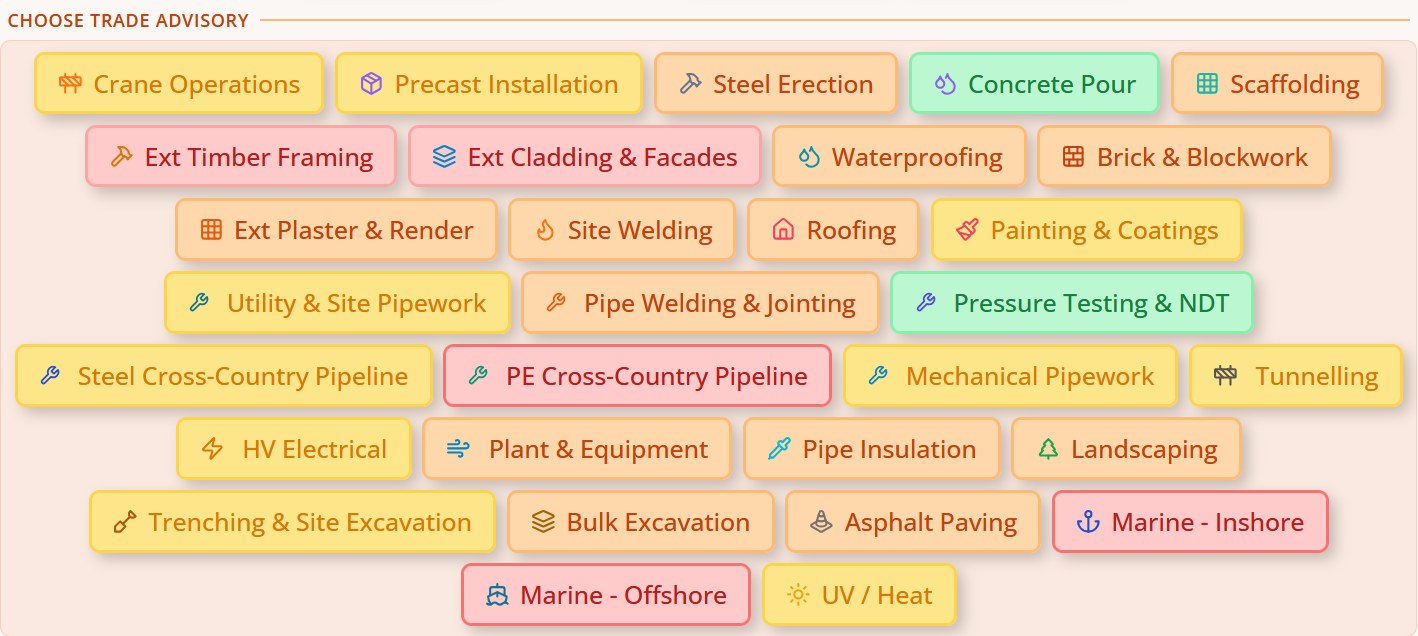
Every construction morning starts the same way: can we proceed with the planned work? Construction Weather gives a structured, trade-specific answer — not a generic rain warning. Green means proceed. Amber means review the hourly breakdown and make a call. Red means the operation threshold is breached.

  • Operation-specific, not generic — a crane lift has different wind limits than a concrete pour; roofing has different rain thresholds than masonry. Each advisory is calculated against the threshold for the selected operation.
  • Industry threshold library — each trade operation has a default threshold set derived from published standards; thresholds are configurable to match project-specific crane manufacturer limits, welding procedure specifications, or contract method statements
  • Automatic contemporaneous record — every advisory check builds a dated, trade-specific weather record. If conditions are later disputed, the daily record is already there.
  • 14-day outlook — plan the week ahead, sequence weather-sensitive operations around the forecast, and avoid expensive mobilise-and-stand-down cycles.
  • Works on any device at the job-site gate — no app to download; add to your phone's home screen in one tap.
Construction weather dashboard showing trade advisory cards with Green, Amber and Red risk levels for daily operations
Example trade-advisory view. Advisory levels and thresholds depend on location and the selected operation.

Data that holds up

Why reproducible, independently verifiable data strengthens weather delay documentation

When a weather delay claim is reviewed by a contracting officer, a disputes board or a project owner's representative, undocumented or unverifiable weather evidence is challenged or denied. Construction Weather uses Open-Meteo ERA5 reanalysis — a publicly accessible global dataset that any party can query independently for the same coordinates and date range.

Why on-site sensors fall short

  • Calibration is challenged — opposing counsel or the contracting officer will question when the device was last calibrated, who maintained it and whether its placement was representative of site conditions
  • No historical baseline — a sensor installed at project start has no pre-contract data; you cannot demonstrate conditions were exceptional without a separate historical dataset
  • Gap risk — power failure or connectivity loss creates holes in the record at exactly the moments that matter most for a claim
  • Cost scales across projects — hardware installation, calibration and retrieval adds cost on every project, every time

What Open-Meteo/ERA5 reanalysis provides

  • Independently reproducible — any party, including an opposing expert, can query the same Open-Meteo Archive API with the same coordinates and date range and retrieve the same underlying ERA5 figures; the data cannot be accused of being fabricated or manipulated
  • Historical baseline built in — the same dataset provides a 5–10 year baseline so you can demonstrate that the adverse month was genuinely unusual for the location and time of year
  • Available immediately, no hardware — works for any US project location from the moment the project is registered; no installation required
  • Stable settled data for completed periods — ERA5 archive data for dates more than 90 days in the past is settled and does not change; the record you build today matches what an independent expert will retrieve later

The practical upshot: Construction Weather uses Open-Meteo ERA5 reanalysis — a publicly accessible, globally peer-reviewed dataset that any expert or contracting officer can query independently. Unlike a consumer app screenshot or a contractor-installed rain gauge, the records it produces are reproducible: the same coordinates and date range return the same values regardless of who runs the query. Platform outputs should be treated as a starting point for expert review rather than a substitute for it in formal disputes; always obtain qualified legal and meteorological advice before filing a claim.

All sectors

Works across all US construction sectors

Weather-related schedule delays and entitlement to time extensions are not unique to building construction. Civil and infrastructure contractors face identical exposure — and the same contract mechanisms to manage it.

Commercial building

Concrete frames, structural steel, curtain wall, roofing and interior fitout — all subject to weather holds under AIA A201 and ConsensusDocs. Document each delay day with a reproducible weather record and support a claim for extended general conditions costs.

Civil and infrastructure

Earthwork fill and compaction suspended by rain, roadbase and paving windows, bridge deck pours — weather delay documentation under state DOT standard specs and AASHTO specifications. The platform's threshold library covers earthworks, road surfacing and piling operations.

Federal construction

Military, GSA, Corps of Engineers and other federal projects operating under FAR-based contracts. Certified data and historical benchmarking aligned to the Request for Equitable Adjustment standard. Defensible against agency review and Armed Services Board of Contract Appeals scrutiny.

Industrial and energy

Large-scale concrete pours (tank bases, equipment foundations), structural welding under wind and humidity constraints, pipeline installation with temperature and moisture limits. Trade-specific thresholds covering all major industrial operations.

Healthcare and institutional

Occupied-site construction with programme pressure from owner milestones. Weather delay documentation supports acceleration claims and preserves the contractor's right to schedule relief under AIA contracts without disrupting the owner relationship.

Multifamily and residential

Concrete slab and framing operations held by rain, roofing and waterproofing windows, exterior envelope work. Price weather risk accurately at bid and protect the programme schedule on high-turnover residential projects.

Further reading

Understanding construction weather delay documentation

Practical guides covering the full project lifecycle — from pricing weather risk at bid through daily site planning to building a successful weather delay claim.

US Delay Claims

Weather delay claims under AIA, ConsensusDocs and FAR contracts

What AIA A201 §8.3, ConsensusDocs 200 and FAR 52.249-10 require for a weather delay claim — the 10-day and 21-day notice deadlines, contemporaneous documentation and proving weather was abnormal with historical benchmarking.

Read the guide →
Bid Planning

Pricing weather risk at bid stage

How to use historical data to calculate realistic weather-day allowances by trade and project month, so weather risk is accurately priced into the bid — not absorbed as a loss during delivery.

Read the guide →
Site Operations

A site manager's guide to daily weather planning

Using construction-specific weather information to plan daily operations — which trades are affected by rain, wind, heat and cold, and how good decisions protect the schedule.

Read the guide →

US Contractor FAQ

Does Construction Weather support AIA and ConsensusDocs contracts?

Yes. Construction Weather is designed to support weather delay documentation for projects operating under AIA A201 General Conditions, ConsensusDocs standard forms, FAR-based federal construction contracts and FIDIC. The platform builds the type of evidence these standard forms require: contemporaneous weather records, trade-specific impact documentation, and a historical benchmark to demonstrate that conditions were genuinely unusual for the location and time of year. Specific notice requirements and entitlement conditions vary by contract; qualified counsel should advise on the formal claims process.

How does Construction Weather help document weather delays?

The platform generates trade-specific weather advisories for 20+ construction operations, allowing site teams to document conditions and their impact on planned work daily. The Delay Evidence Generator then benchmarks the affected project period against a 5–10 year historical baseline for the same location — providing objective evidence that conditions were genuinely unusual. That type of comparison against historical norms is a common requirement when demonstrating weather delay entitlement under AIA, ConsensusDocs and FAR-based contracts.

Can this help with federal construction contract weather delays?

Yes. Fixed-price federal construction contracts commonly include FAR 52.249-10, which treats unusually severe weather as an excusable delay and can support a schedule adjustment. Demonstrating entitlement requires showing that conditions were genuinely unusual for the location and time of year — and that the delay affected work that was otherwise on schedule. Construction Weather provides Open-Meteo ERA5 reanalysis data and 5–10 year historical benchmarking — reproducible, publicly verifiable records that any party can independently query for the same coordinates and date range. Specific remedies and the formal claims process should be handled with qualified counsel.

What weather thresholds does the platform use for construction operations?

Construction Weather includes a library of default trade thresholds for operations including crane lifts, concrete placement, roofing, earthworks, structural welding, scaffold erection and more. Thresholds are configurable: project teams can adjust them to match crane manufacturer limits, welding procedure specifications, or contract method statements. The platform provides a structured, documented basis for operational decisions — and each advisory check builds a dated weather record for the selected operation. Advisory outputs are decision-support tools; manufacturer instructions, competent-person judgment and applicable regulations always govern on site.

Is Construction Weather available for sites across the United States?

Yes. Construction Weather provides weather intelligence for any construction site location in the United States and worldwide. Enter a project address and the platform returns forecasts, historical records and benchmarking data for that exact location — no on-site hardware required.

How is this different from a weather app or AccuWeather?

A weather app tells you it will rain. Construction Weather tells you whether that rain — or wind, heat, cold or humidity — actually stops the specific trade operation you have planned. Outputs are structured for construction contract administration, not general public use: trade-specific daily advisories, structured weather notice drafts, and a delay evidence pack benchmarked against historical records. It is designed to be used by project managers, site superintendents and commercial teams — not just checked like a forecast.
Start documenting weather delays the right way

Protect your schedule, meet your notice requirements and build a reproducible weather record that supports a weather delay claim.

Try Construction Weather