P&G cost recovery
Prolongation costs — site accommodation, supervision, plant hire — are only recoverable if the delay is documented. Daily weather records created at the time are worth far more than a reconstruction months later.
For site managers & supervisors
A normal weather app tells you it will rain. Construction Weather tells you how that rain — or wind, frost, heat or gust — affects the operation you have planned. Green, Amber and Red risk grading across 29 construction trades, with a 14-day outlook and the weather records that protect you when the programme slips.

Your daily planning tool
Every morning, site managers face the same decision: can this operation run today? Construction Weather answers that question with operation-specific data rather than a generic forecast.
Select a trade — concrete, craneage, roofing, earthworks, welding — and review a daily Green, Amber or Red advisory. Flagged days can be drilled into at hourly resolution so you can plan timing and consider mitigation before committing crew and plant.
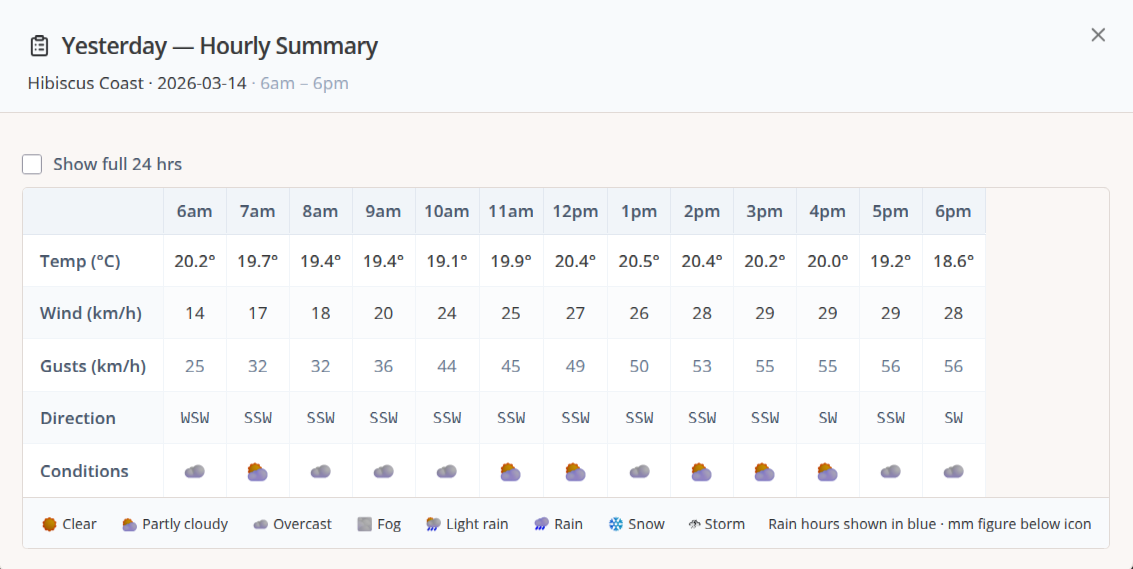
The financial risk most site managers don't know about
Most site managers know the forecast risk. Fewer know the contractual one. When adverse weather delays the works, the contractor's entitlement to an extension of time — and recovery of P&G overhead, prelim costs and protection from liquidated damages — depends entirely on the quality of the contemporaneous weather record.
Prolongation costs — site accommodation, supervision, plant hire — are only recoverable if the delay is documented. Daily weather records created at the time are worth far more than a reconstruction months later.
If the programme slips and the employer starts applying LDs, weather is often the main defence. That defence collapses if there are no records to show which days were affected and which trades were stopped.
Construction Weather presents advisory and forecast data tied to your project location. Teams can use those outputs alongside site records when QS and commercial teams compile a time-extension review.
Platform outputs are decision-support information. Contractual entitlement is determined by contract terms, programme analysis and legal interpretation — not the platform.
Weather affects different trades very differently. Each advisory is matched to the parameters relevant to the selected operation — not a generic forecast.
Wind speed and gusts — graded against manufacturer-specified limits for the crane type and configuration.
Rainfall intensity, temperature (min/max), wind and humidity — covering placement, finishing and curing.
Wind and gust conditions relevant to erection and alteration of tube, system and special scaffolding.
Rain, wind and temperature — covering membrane installation, lap sealing and adhesive application conditions.
Rainfall intensity and frost — covering trafficability, compaction and slope stability conditions.
Rain, frost and temperature — covering mortar setting conditions and protection requirements.
Wind, gusts and rain — covering both crane-assisted placement and slip risk on structural steel sections.
Humidity, dew point spread, temperature, rainfall and wind — covering the application window for industrial coatings.
Ambient and substrate temperature, rainfall and wind — covering placement and compaction window conditions.
Instant site check
The live rain radar — available on the homepage and inside the platform — gives you a real-time picture of rainfall across your site area. Animated frames show the last hour of observations plus a short-range nowcast, so you can see whether that band of rain will clear before the pour starts.

Construction Weather covers the full project lifecycle. The same location and project data that powers your daily advisory also feeds the early-warning notices, time-extension evidence and tender planning tools.
Issue contractual early-warning notices before adverse conditions arrive. Protect the programme with contemporaneous records that underpin any future delay claim.
Project manager guide →Benchmark the affected project month against historical data and organise time-extension evidence for review — framed around the contract clause and the project's delay-cost and P&G records.
QS guide →A practical guide to daily construction planning using construction-specific weather information — which trades are affected, and how good decisions protect the programme.
Read the guide →Common Questions
A normal weather app tells you it will rain. Construction Weather helps you assess how that rain — or wind, frost, heat, humidity or gust — may affect the specific operation you have planned. Each advisory is matched to the weather parameters relevant to the selected trade, not a generic forecast description.
29 construction trade operations, including crane and lifting, scaffold erection, steel erection, concrete placement, welding, painting and coatings, blasting, roofing and waterproofing, cladding, masonry, earthworks, road surfacing, external render, piling, glazing and timber framing. Each is matched to the weather parameters relevant to that trade.
Yes. The notifications section lets you configure project-specific alert thresholds — wind speed, rainfall intensity, temperature, humidity, dew point — so alerts reflect your crane manufacturer's limits, WPS, coating data sheet or contract method statement rather than generic defaults.
Construction Weather stores daily advisory data for your project location. When the QS or PM compiles an time-extension claim, they can access the contemporaneous advisory record showing which days were flagged for which trades. Records created at the time carry far more weight than reconstructions made months later.
Yes. The platform covers earthworks, piling, road surfacing, steel and concrete operations common to civil and infrastructure work, in addition to the building trades. It works for any project where weather affects outdoor construction operations.
Trade-specific advisories, 14-day outlook and weather records for site managers across the project lifecycle.