Contemporaneous records
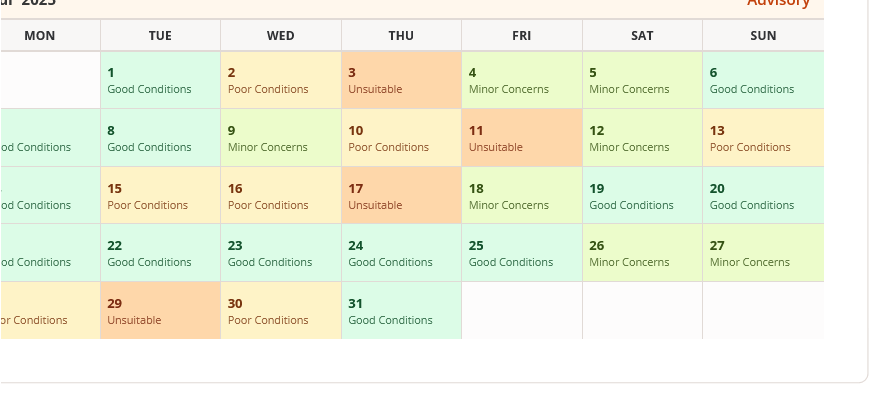
Advisory and forecast data presented against the project location can be reviewed alongside contemporaneous site records when a claim is being assessed.
For quantity surveyors & commercial teams
Benchmark the affected project month against the five- or ten-year historical average, identify qualifying weather events and frame the evidence around the contract clause — NEC, JCT or FIDIC. Construction Weather gives QS teams the data infrastructure for a defensible adverse weather claim.

time-extension claim evidence
A successful weather time-extension claim needs more than a list of wet days. It needs to demonstrate that conditions exceeded the norm for the location and time of year, that the contractor's operations were actually affected, and that the notice obligations in the contract were met.
Construction Weather provides the benchmarking layer — comparing the affected project month against the five- and ten-year historical average — and presents the output in a format structured around the contract clause in use: NEC3, NEC4, JCT or FIDIC.
Prolongation and preliminaries
Recovering prolongation costs — site accommodation, management, hired plant — requires more than a programme delay. It requires evidence that the delay was caused by an event beyond the contractor's control, that it was recognised at the time, and that the commercial consequences were quantified. Construction Weather supports each of those requirements.
Advisory and forecast data presented against the project location can be reviewed alongside contemporaneous site records when a claim is being assessed.
The benchmark comparison demonstrates whether conditions exceeded the norm — the key threshold test under most standard form contracts before P&G prolongation is recoverable as a weather-related cost.
When the employer begins applying liquidated damages for programme slippage, a well-evidenced weather time-extension claim is the primary contractual defence. The evidence pack built in Construction Weather is structured to support that defence.
Platform outputs are decision-support information and do not determine contractual entitlement. Seek qualified legal or contractual advice before issuing formal notices or claims.
Historical data
Construction Weather draws on up to ten years of historical daily and hourly weather data for project locations worldwide. For QS teams compiling time-extension evidence, this means the benchmark comparison is available immediately — no waiting for met-office reports or third-party data requests.
The same historical dataset also underpins the tender planning tool, so the weather risk allowance built into the original contract can be compared directly with what actually occurred during construction — a comparison that is often central to a contested EOT negotiation.
Contract clause alignment
Weather time-extension claims fail for contractual reasons as often as evidential ones. Construction Weather aligns its evidence outputs to the adverse weather provisions of the main standard form contracts — so the claim arrives framed in the language the engineer, employer or adjudicator expects.
Weather measurement and Compensation Event 60.1(13) — conditions worse than the weather data in the contract data at the project location.
Contract clause guide →Relevant Event — exceptionally adverse weather conditions. The benchmark evidence produced by the platform supports the "exceptionally adverse" threshold requirement.
Contract clause guide →Unforeseeable physical conditions and force majeure provisions — benchmarked historical data supports foreseeability analysis at the location of the works.
Contract clause guide →The time-extension evidence the QS compiles at the end of the project is only as strong as the records created during it. Construction Weather connects every stage — from the tender allowance through the site manager's daily check to the QS's final claim.
Issue contractual early-warning notices before adverse weather arrives and maintain the contemporaneous records that underpin the QS's future claim.
Project manager guide →Use the same historical dataset at tender stage to price weather risk accurately — so the contract allowance can be compared with actual conditions later.
Tender team guide →The four elements every successful weather time-extension claim must address, the contractual notice requirements that protect entitlement, and how to build evidence from day one.
Read the guide →Common Questions
The benchmark compares the weather conditions recorded during the affected project month against the five- or ten-year historical average for the same location and calendar month. It shows whether conditions were worse than the norm — the primary evidential test for "exceptionally adverse weather" under JCT and "weather worse than the weather data" under NEC.
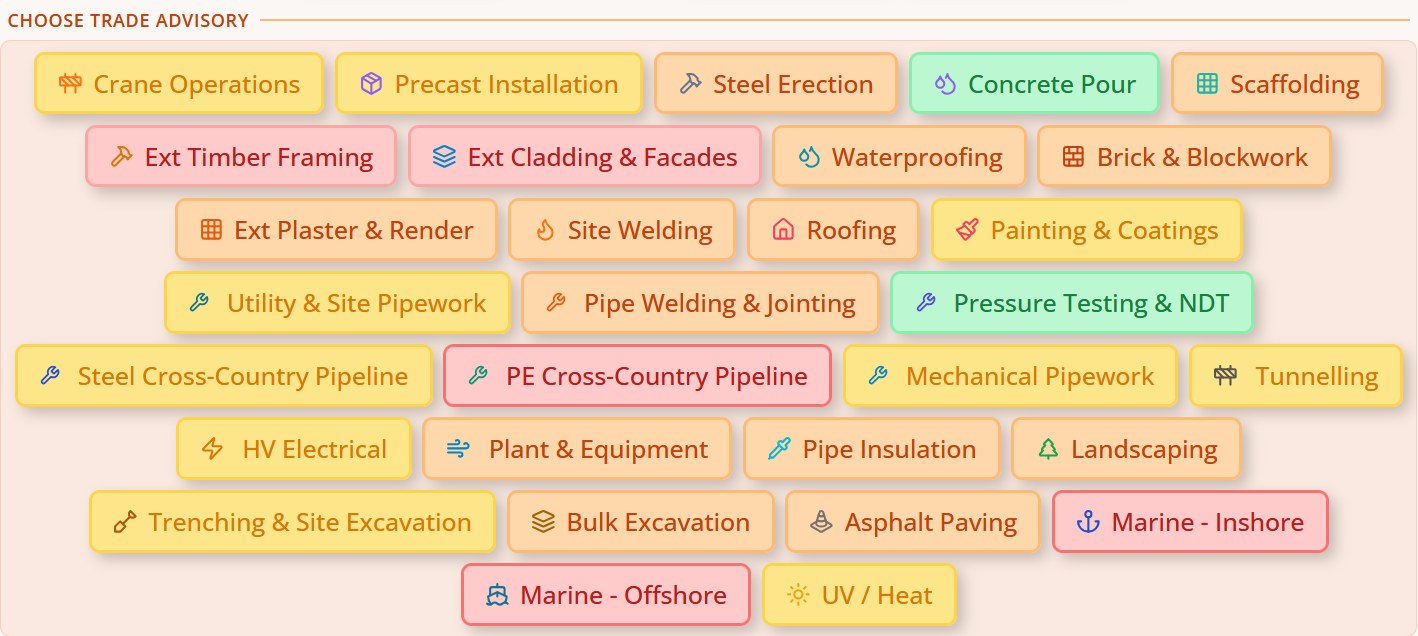
The platform applies the threshold parameters relevant to the selected trade operations — rainfall intensity, wind speed, temperature, humidity — and identifies days where conditions exceeded those thresholds. The output shows which days, which parameters and by how much, providing the event-level detail the claim requires.
Yes. Historical records, benchmark comparisons and advisory summaries can be exported to Excel. The platform also generates report graphics — charts and tables — suitable for inclusion in time-extension claim submission documents.
The platform aligns to NEC3, NEC4, JCT and FIDIC adverse weather provisions. The output structure reflects the language and thresholds used in each contract form — weather measurement and Compensation Event 60.1(13) under NEC, exceptionally adverse weather under JCT, and foreseeability benchmarking relevant to FIDIC.
No. Construction Weather provides weather data, historical benchmarks and structured evidence packs for QS review. Determining contractual entitlement, programming the delay impacts and presenting the claim requires the judgement of a qualified QS, claims consultant or delay expert — the platform is a data and evidence tool, not a claims service.
Benchmarked historical data, qualifying event identification and contract-aligned evidence packs for QS and commercial teams.