Weather benchmarking: what 'once in ten years' means for your time-extension claim
How the 90th-percentile threshold is calculated from historical data and how it applies under NEC4, AS 4000, NZS 3910 and JCT contracts.
Evidence, not fragments
Benchmark a project month against historical weather to identify potential qualifying events and prepare editable time-extension evidence for review.
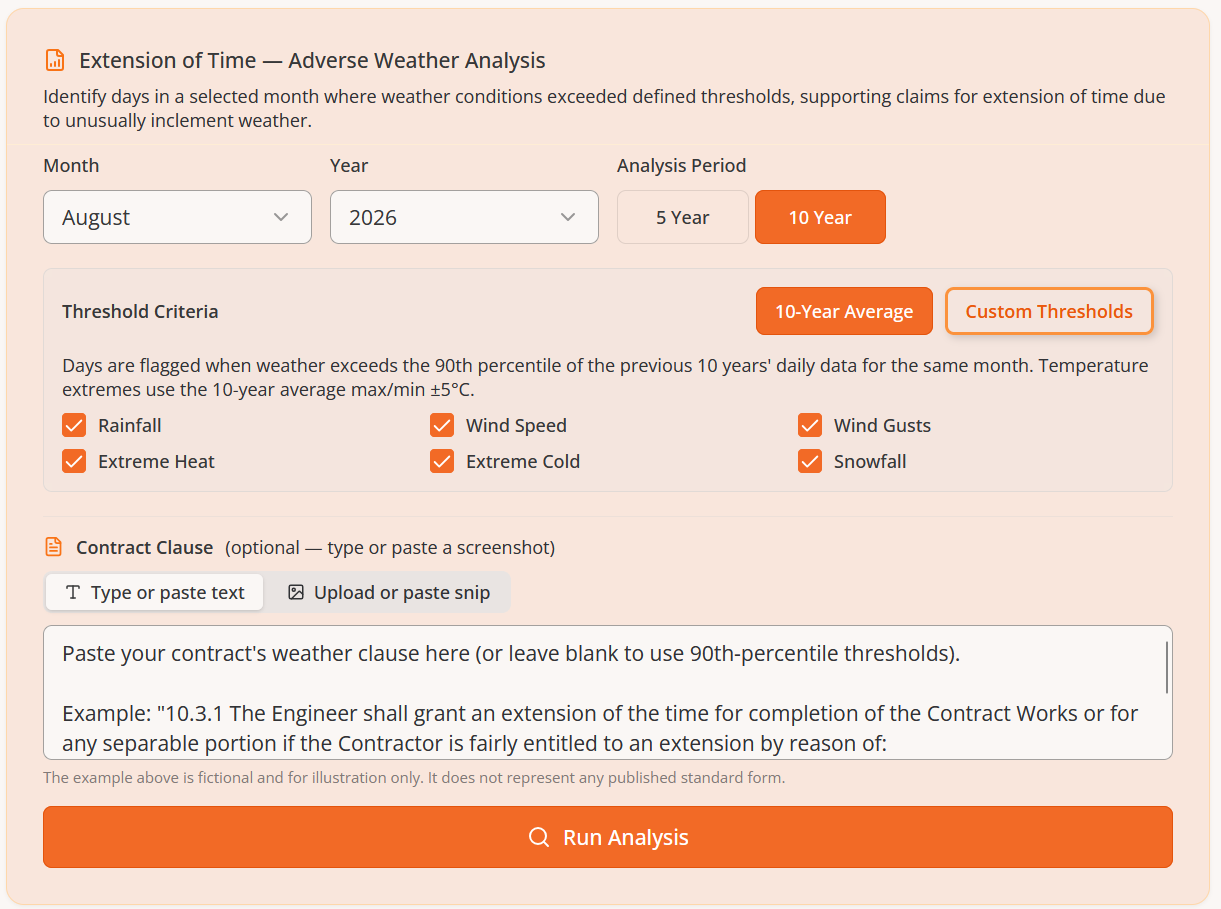
The EOT Evidence Generator compares a selected month with five or ten years of historical data. It can establish percentile thresholds for configured weather measures and identify days that exceed the resulting benchmark.
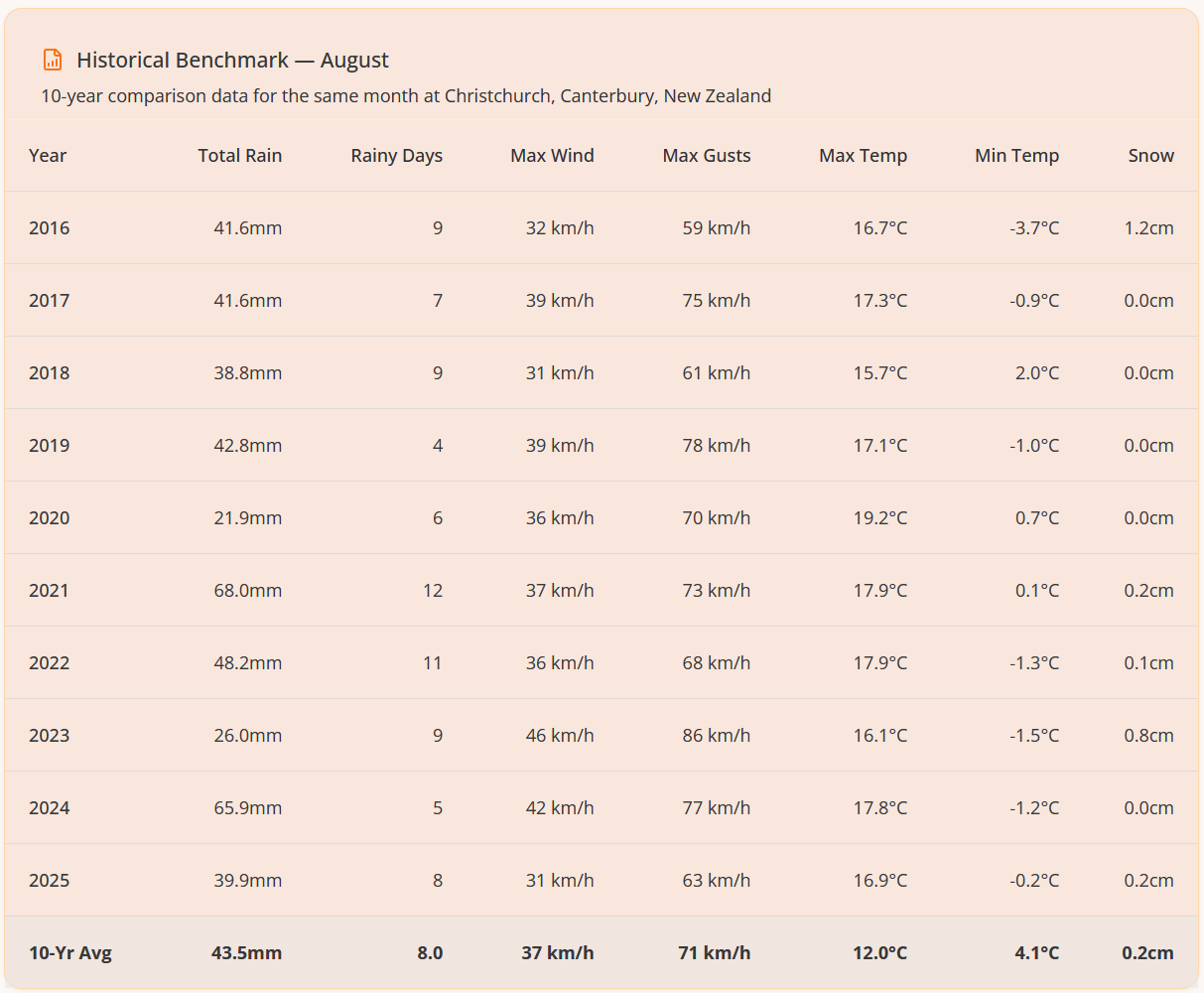
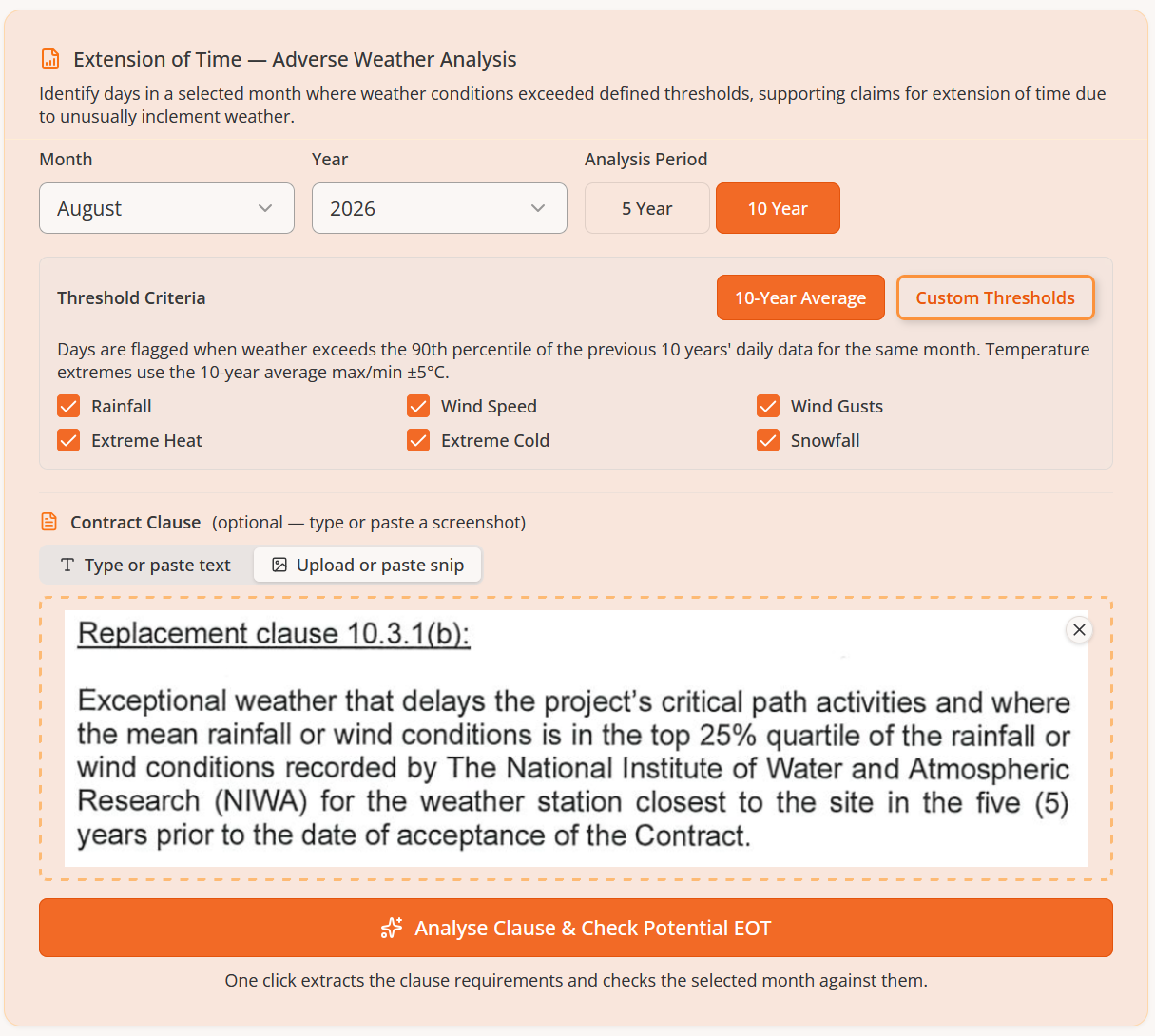
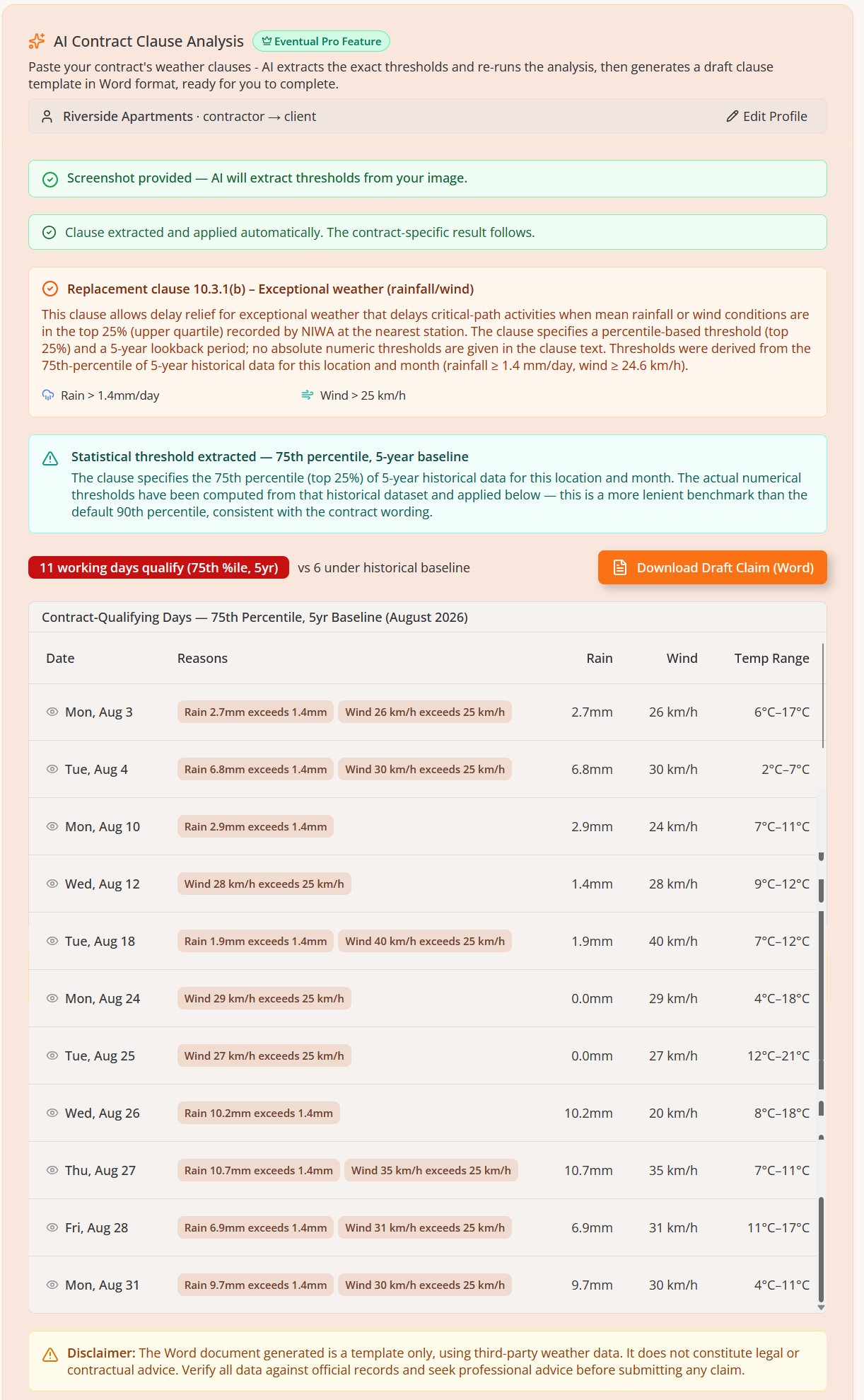
A weather event does not automatically create entitlement. The relevant contract establishes the test, notice requirements and available relief. The platform can use supplied weather clauses to help structure the analysis and identify events for further review.
Choose the location and period being assessed.
Use the appropriate historical period and configured measures.
Check the source data, thresholds and classification.
Add site records, affected activities and programme evidence outside the weather analysis.
A complete extension-of-time submission commonly requires more than weather data, including timely notices, contemporaneous records, programme analysis, causation and compliance with the applicable contract.
Worked example / template
This is an illustrative outline for a civils weather review — not a real case, not a customer report and not an automatically generated claim. It shows where weather information ends and project evidence begins.
| Pack section | What the worked example / template shows | Boundary and completion note |
|---|---|---|
| 1. Purpose and scope | A blank project brief identifying the review period, location and question being tested. | Template only. It does not state that a delay occurred or that relief is due. |
| 2. Weather provenance | Source, dataset, requested coordinates, date range, units, retrieval time and the distinction between historical reanalysis, forecast and radar. | Weather data is location-based and not a measurement taken at the site. Keep the source context with the export. |
| 3. Assumptions and method | Selected benchmark period, trade or weather parameters, thresholds, calendar, timezone and treatment of missing values. | Confirm each assumption against the contract and the actual method of work; assumptions are not site facts. |
| 4. Missing data to complete | A checklist for site diaries, photographs, daily reports, station records, notices, programme files, activity records and mitigation evidence. | A blank or unavailable item remains missing; do not infer it from a weather value. |
| 5. Weather event analysis | The dates, parameters and threshold comparisons that identify potential weather events. | Weather boundary: this describes weather conditions only; it does not prove an affected activity or delay. |
| 6. Activity impact | Placeholders for the planned activity, actual work performed, resources, access, mitigation and contemporaneous site evidence. | Activity boundary: the project team must show what work was affected and why the weather mattered to that work. |
| 7. Programme analysis | Placeholders for baseline and updates, logic, float, critical path, sequencing, concurrency and mitigation effects. | Programme boundary: a weather event is not automatically critical-path delay; a planner must analyse the programme. |
| 8. Clause inputs and entitlement review | Contract and clause reference, weather test, notice requirements, relevant dates, causation and relief sought. | Entitlement boundary: the platform does not determine automatic entitlement. Contract, project, planning and legal review remains required. |
Related reading
How the 90th-percentile threshold is calculated from historical data and how it applies under NEC4, AS 4000, NZS 3910 and JCT contracts.
Construction Weather covers the full project weather cycle — from tender through to extension-of-time evidence.
See daily Green, Amber or Red risk gradings for 29 trade operations, with hourly drill-down for flagged days.
Turn forecast risks into editable early-warning notice drafts for project-team review before conditions arrive.
Use ten years of historical data to estimate average unsuitable days by operation and project month at the proposed location.
Retrieve dated weather records for any project location and export them for reports, delay reviews and project records.
See how quantity surveyors use time-extension evidence tools to benchmark project weather, identify qualifying events and build a submission that stands up to scrutiny.
Common Questions
An extension of time (EOT) for weather is a contractual mechanism that entitles a contractor to additional time when adverse or exceptional weather conditions have delayed progress. Under NEC contracts this is treated as a compensation event; under JCT contracts it is a relevant event. The contractor must demonstrate that weather conditions exceeded the applicable benchmark, that the work was affected, and that the delay impacted the critical path. A weather time-extension claim typically requires benchmark data, site records, programme evidence and compliance with notice requirements.
The EOT Evidence Generator compares weather conditions during a selected project month against a five- or ten-year historical benchmark for the same location and calendar period. It uses ERA5 reanalysis data from the Open-Meteo Archive API to identify days on which configured weather thresholds — for rain, wind, frost, snow or other parameters — were exceeded. The tool produces a benchmarked list of potential qualifying events, an Excel weather data export and a formatted draft evidence document for project and contracts team review.
ERA5 reanalysis is produced by ECMWF, an intergovernmental organisation supported by 35 European states, and is one of the most widely cited global climate datasets in peer-reviewed research. It is publicly accessible via the Open-Meteo Archive API, meaning any party can independently reproduce the same figures for the same coordinates and date range. For most construction EOT reviews it provides data that is fit for purpose. For very high-value disputes, a meteorological expert should be instructed to review and supplement the platform data.
The generated evidence document records the project location, the benchmark period used, the weather parameters and thresholds applied, and the days identified as potentially qualifying. It is produced as an editable Word document so project and contracts teams can add site records, programme information and causation commentary. The document supports disclosure to the other contracting party and is structured around the information typically required for an extension-of-time submission.
No. The platform identifies weather events that may qualify under the applicable contract, but establishing entitlement requires more than weather data. A complete EOT submission typically requires timely notices, contemporaneous site records, programme analysis demonstrating critical-path effect, and expert review of causation and contract compliance. The platform's outputs are decision-support information; entitlement must be confirmed with suitably qualified project, planning and legal advisers.
Explore construction-focused forecasts, historical records and reporting tools for your next project location.