Step 1 — Set the location
Enter the project site location. The platform draws on historical weather data for that specific point — not the nearest large city or regional average.
For tender & pre-construction teams
Most tender weather allowances are guesses. Construction Weather replaces the guess with ten years of location-specific historical data — unsuitable-day counts by trade operation and project month, so the weather risk in your programme is accurately priced before the contract is signed.

The tender weather problem
Weather is one of the few genuine unknowns in a construction tender. Most teams handle it with a rule of thumb — a fixed number of days per month, or a percentage of programme time. The problem is that this allowance applies the same number to a concrete operation in January as to a steelwork operation in June, at a location in Aberdeen and a location in Seville.
When the allowance runs out mid-programme and the weather keeps coming, the P&G overruns land on the contractor. The original allowance was wrong — it was never based on the actual historical weather at that location, for those trades, in those programme months.
How the tender planning tool works
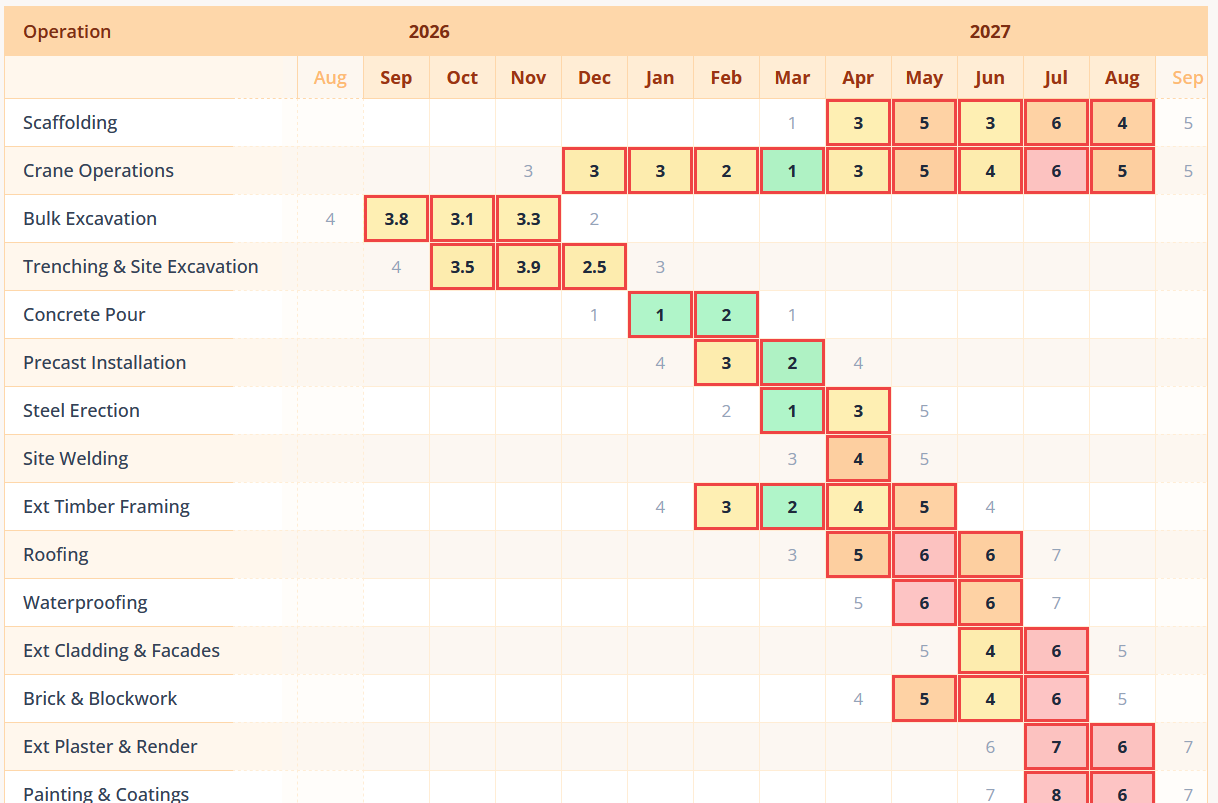
Enter the project location and programme start date. The platform applies the historical weather record to each selected trade operation, month by month, and returns the average number of unsuitable days for each combination. The result is a data-backed allowance you can carry directly into the pricing document.
Enter the project site location. The platform draws on historical weather data for that specific point — not the nearest large city or regional average.
Choose the trade operations relevant to your programme — concrete, earthworks, craneage, roofing, steel — and map them to the project months when each trade is planned to be on site.
The platform returns the ten-year average unsuitable-day count for each trade and month. Carry the figure directly into your programme float and preliminaries pricing. Export to Excel for the tender appendix.
One dataset — tender to claim
The historical data used to build the tender allowance is the same dataset the QS draws on when compiling the time-extension evidence at the end of the project. This matters in a contested EOT negotiation: the comparison between what was priced at tender and what actually occurred during construction is far simpler when both figures come from the same source.
If actual weather during construction was significantly worse than the historical average — worse than a reasonable estimator could have priced — that comparison supports the contractor's case for an extension of time and prolongation recovery.
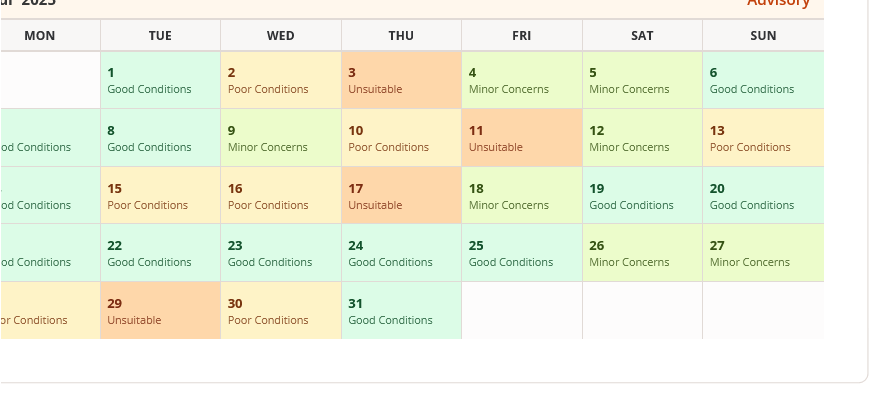
Getting the weather allowance right at tender isn't just about accuracy — it's about protecting the project before it starts. These are the costs that typically run over when the allowance is wrong.
Site accommodation, supervision time, welfare facilities and hired plant run for longer when weather delays extend the programme. These costs need to be in the price — not absorbed as a loss mid-project.
Programme float built into subcontract packages protects the main contractor when weather delays one trade and the knock-on hits another. Float that was never there at tender cannot be claimed back later.
A programme with no weather float is a programme that is already running late from day one. Accurate weather allowances give the programme the room it needs — and give the contractor a defensible position if LDs are later applied.
Temperature, frost and rainfall constraints on concrete placement, curing and finishing make winter concreting significantly more weather-dependent than summer. A month-by-month trade breakdown prices this correctly.
Coastal, upland and exposed urban sites have significantly more weather days than sheltered inland locations. A location-specific allowance captures this — a national rule of thumb does not.
If the programme start date is flexible, the tender planning tool can be run against alternative start dates to identify the option with the lowest weather risk — a comparison that sometimes changes the bid strategy entirely.
The work done at tender stage shapes every weather decision that follows. Construction Weather connects the tender allowance to the site manager's daily check and the QS's final account — through one platform, one location-based dataset.
Trade-specific daily advisories — Green, Amber, Red — so the crew is only committed when conditions allow and the weather record is built from day one.
Site manager guide →time-extension evidence benchmarked against the same historical dataset used at tender — so the comparison between priced allowance and actual conditions is immediate.
QS guide →What weather risk at tender means, how to quantify it by trade using historical data, and how to build a defensible weather contingency into the bid.
Feature page →How to use historical data to calculate realistic unsuitable-day allowances by trade and month, and why the location matters more than most estimators expect.
Read the guide →Common Questions
The tender planning tool draws on up to ten years of historical daily weather data for the project location. The unsuitable-day counts shown represent the ten-year average for each trade operation and calendar month — giving a statistically stable basis for the tender allowance rather than relying on a single year that may have been unusually good or bad.
Yes. Because the analysis is month-by-month, running the tool against alternative start dates produces different unsuitable-day profiles — useful for identifying the programme sequencing with the lowest weather risk, particularly for critical external trades like concrete, roofing and earthworks.
An unsuitable day is one on which forecast or historical conditions exceed the advisory threshold for the selected trade operation — the wind speed limit for craneage, the rainfall intensity limit for concrete placement, the frost threshold for masonry, and so on. The thresholds are matched to the parameters used in the trade advisory feature, so tender and site planning use the same definitions.
Yes. The historical data and unsuitable-day analysis can be exported to Excel, providing the data appendix for the tender submission. The export shows the location, the date range, the selected trade operations and the unsuitable-day counts — a transparent record of how the allowance was calculated.
Yes. The historical dataset used to build the tender allowance is the same one the QS draws on when compiling time-extension evidence. This consistency is significant in a contested EOT negotiation — the comparison between the priced allowance and what actually occurred is clean and auditable, rather than drawing on two different sources that can be disputed separately.
Ten years of location-specific historical data — unsuitable-day counts by trade and month — for tender and pre-construction teams.