Preliminary overruns
Site establishment, supervision, plant and welfare costs continue while weather-affected operations are suspended. When the programme runs long due to weather, prelims overrun the tendered sum without recovery.
Tender weather risk
Underpricing weather risk at tender is one of the most common causes of project losses. Construction Weather gives pre-construction teams the historical data to price it correctly — operation by operation, month by month, at the actual site location.
The fundamental problem
Every construction programme contains weather-sensitive operations — crane lifts, concrete pours, steelwork erection, earthworks, roofing, painting. Each of those operations has a weather threshold beyond which the work stops. Every day that work stops costs money: plant standing, labour standing, preliminaries running.
Weather risk at tender is the question of who absorbs those costs if the weather exceeds the assumed allowance. Under most standard contracts — NEC3, NEC4, JCT, FIDIC — the risk allocation depends on what was priced in. A contractor who has priced a realistic allowance has a defensible position when delays arise. A contractor who used a generic rule of thumb has absorbed the risk without knowing it.
The problem is not that weather is unpredictable. It is that the historical pattern at each location, for each trade, in each calendar month, is knowable — and most tender teams do not use it.
The cost of getting it wrong
A generic weather allowance looks adequate at tender. The problems appear during construction.
Site establishment, supervision, plant and welfare costs continue while weather-affected operations are suspended. When the programme runs long due to weather, prelims overrun the tendered sum without recovery.
Teams accelerate to recover the delay — overtime, additional resources, resequencing. The cost of acceleration is rarely recoverable unless the EOT entitlement was established and the weather risk was correctly allocated in the contract.
An extension-of-time claim under NEC or JCT requires that weather exceeded the applicable benchmark. If the tender did not establish a credible benchmark, the contractual position is harder to defend when delay has already occurred.
Quantifying the risk
The right starting point for a weather contingency is the historical frequency of unsuitable conditions — by trade, by month, at the actual project location. A concrete operation in January at an exposed coastal site has a different risk profile from the same operation in July in a sheltered urban location.
Construction Weather retrieves ten years of ERA5 reanalysis data for a given location and calculates, for each calendar month, the average number of days on which configured weather thresholds would have been exceeded for the selected trade. This gives the tender team a defensible, independently verifiable starting point for the weather allowance.
Building the contingency
A historical unsuitable-day figure is the foundation, not the complete answer. The contingency calculation also needs to account for how weather loss translates into project cost at this specific project.
Use ten years of location-specific data to establish the expected frequency of weather-affected days for each weather-sensitive activity in the programme.
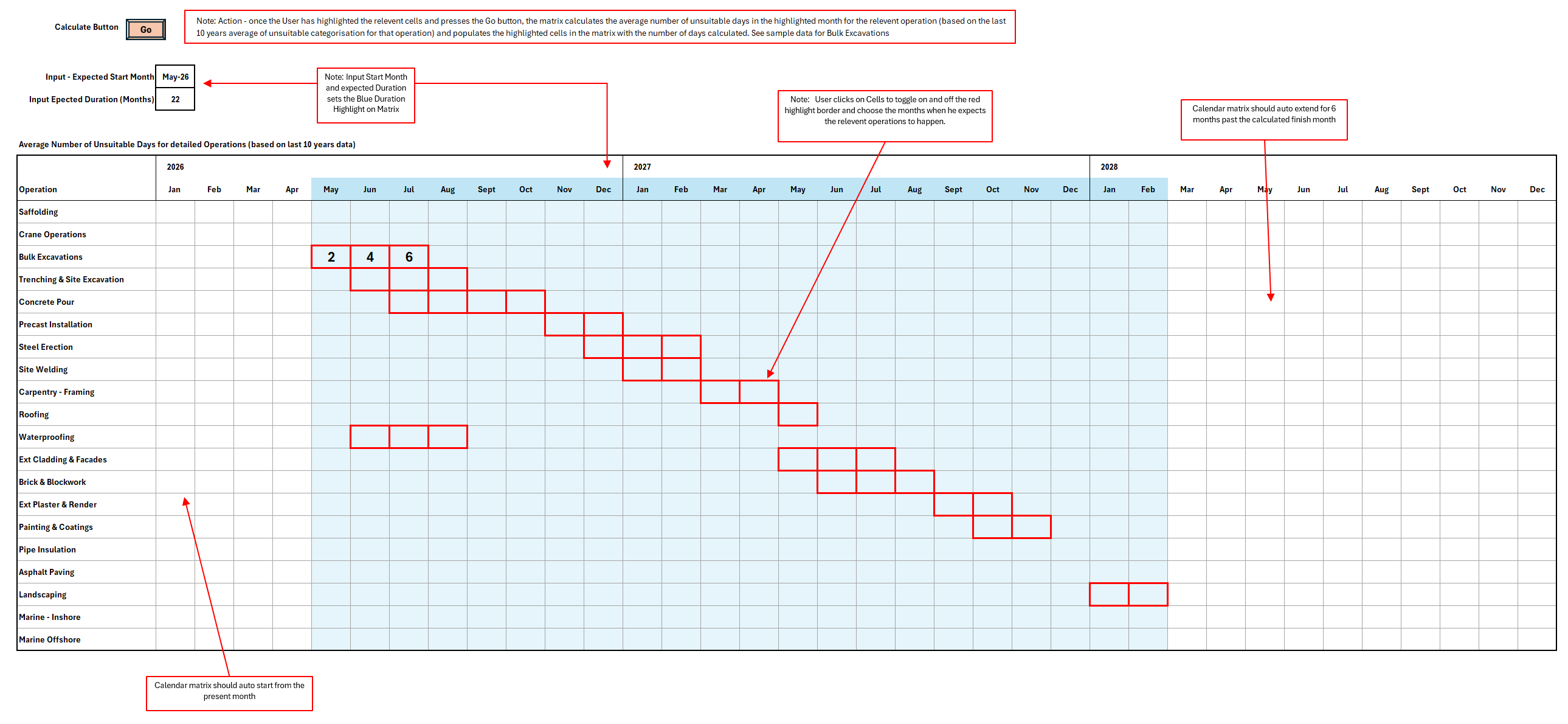
Assign each calendar month's unsuitable-day figure to the relevant trade operation in the planned programme. Identify where weather-sensitive activities cluster and whether alternative start months improve the weather profile.
Estimate the daily cost of a weather stoppage for each trade — plant standing, labour, supervision, welfare — and multiply by the expected unsuitable-day count to produce an operation-level weather contingency figure.
Sum across operations to build the total weather contingency. Document the methodology: historical data source, threshold settings, daily cost assumptions and programme assumptions. This documentation supports any future EOT assessment.
The Tender Planning tool
The Tender Planning tool in Construction Weather is built around this workflow. It retrieves and displays ten-year average unsuitable-day counts for the selected trade, location and project month in a matrix that maps directly onto a programme sequence.
Tender teams can compare adjacent months — useful when assessing whether a programme start-date change would improve the weather exposure on a critical operation. The output can be exported for inclusion in tender documents and for audit purposes if the allowance is later challenged.
Related reading
A full guide to the methodology — how to translate historical unsuitable-day data into a defensible weather contingency and what to include in the tender submission.
Construction Weather covers weather risk across the full project lifecycle — from pre-bid planning to extension-of-time evidence.
Walk through the Tender Planning workflow — setting location, assigning operations and reviewing the ten-year unsuitable-day matrix.
Once the project is live, see daily Green, Amber or Red risk gradings for 29 trade operations, with hourly drill-down for flagged days.
Turn forecast risks into editable early-warning notice drafts — creating the contemporaneous record that supports any future EOT review.
Benchmark a project month against historical data and identify potential qualifying weather events when an extension-of-time claim arises.
Use ten years of location-specific historical data to build a defensible weather contingency for your next tender.